
Methodology
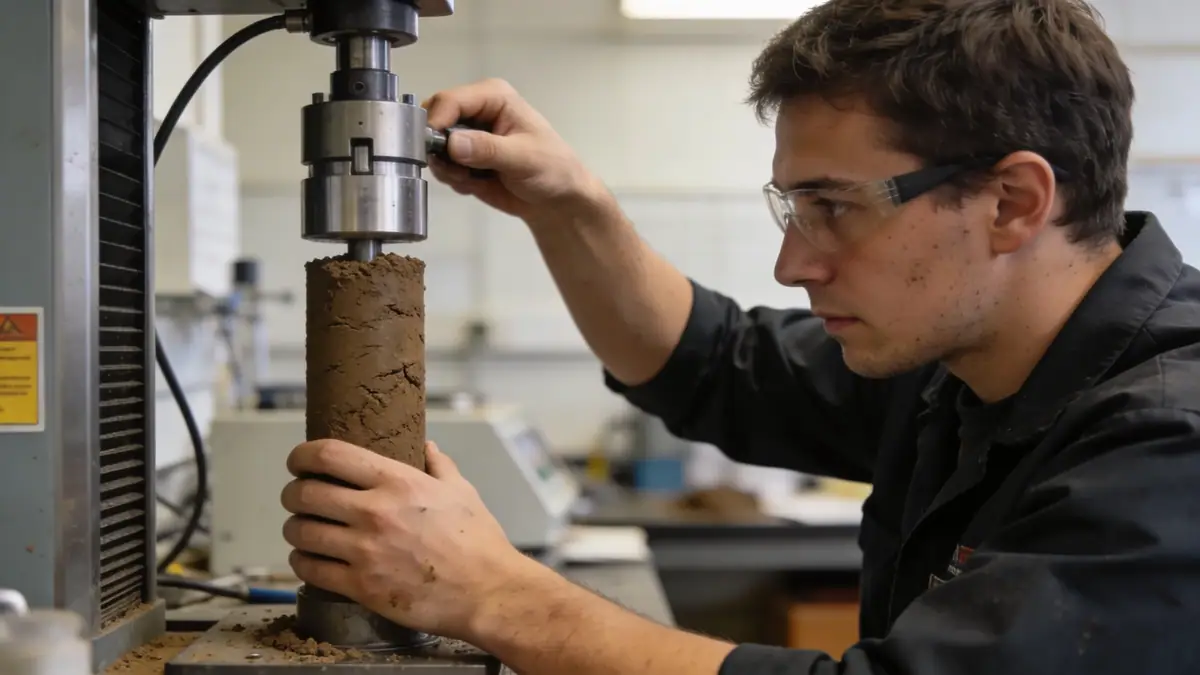
Our methodology for standard penetration test (SPT) in West Valley City follows ASTM D1586, with boreholes advanced using hollow-stem augers or mud rotary techniques. We record blow counts at 1.5-meter intervals to obtain N-values, which are corrected for overburden pressure and hammer efficiency. Our field team logs soil types, groundwater conditions, and sampling depths. Data is processed to generate N60 and N1,60 profiles for seismic site classification per ASCE 7. We also conduct adjacent cone penetration test (cpt) soundings where continuous stratigraphic detail is required.
Reference Technical Parameters
| Parameter | Reference Value |
|---|---|
| Predominant soil type | Clayey silts and sandy clays with occasional gravel layers |
| Maximum seismic acceleration (PGA) | 0.4g to 0.6g (Site Class D, ASCE 7) |
| Typical groundwater level | 3 to 6 meters below grade |
| Bedrock depth | Variable; 30 to 60 meters in valley fill |
| Typical N60 range | 4 to 25 blows per 0.3 m in upper 15 meters |
Local Considerations — West Valley City
West Valley City lies within the Salt Lake Valley, underlain by alluvial and lacustrine deposits from ancient Lake Bonneville. The proximity to the Wasatch Fault zone imposes high seismic risk, requiring site-specific liquefaction and lateral spread evaluations. Our team routinely encounters shallow groundwater and soft cohesive soils in the eastern sectors, while the western areas exhibit denser granular layers. We integrate dpsh dynamic probing for rapid profiling in urban infill projects. For projects requiring regional reference, our standard penetration test en Denver hub provides comparative basin-scale insights.
Request a Quote
Our team reviews your project and issues an initial report at no cost.
Or write us directly at [email protected]
Services in West Valley City
Applicable Standards
- ASTM D1586
- ASCE 7-22
- 2021 International Building Code (IBC)
- Utah Seismic Safety Commission guidelines
Frequently Asked Questions
What soil conditions are typical for standard penetration test in West Valley City?
The valley fill consists of interbedded silts, clays, and sands with occasional gravel. SPT N60 values range from 4 to 25 in the upper 15 meters, with deeper strata often densifying. Groundwater is typically encountered between 3 and 6 meters.
How does the Wasatch Fault affect SPT requirements in West Valley City?
The fault zone imposes high seismic hazard, requiring Site Class D or E classification per ASCE 7. SPT data is used to evaluate liquefaction potential, cyclic strength, and site amplification. The 2021 IBC mandates site-specific response spectra for structures in this area.
Is a standard penetration test mandatory for residential construction in West Valley City?
While not universally required, the city enforces IBC provisions for seismic design. For most residential projects, a geotechnical report including SPT is recommended to assess soil bearing capacity and liquefaction risk. Local building officials often request SPT data for permits.