
Methodology
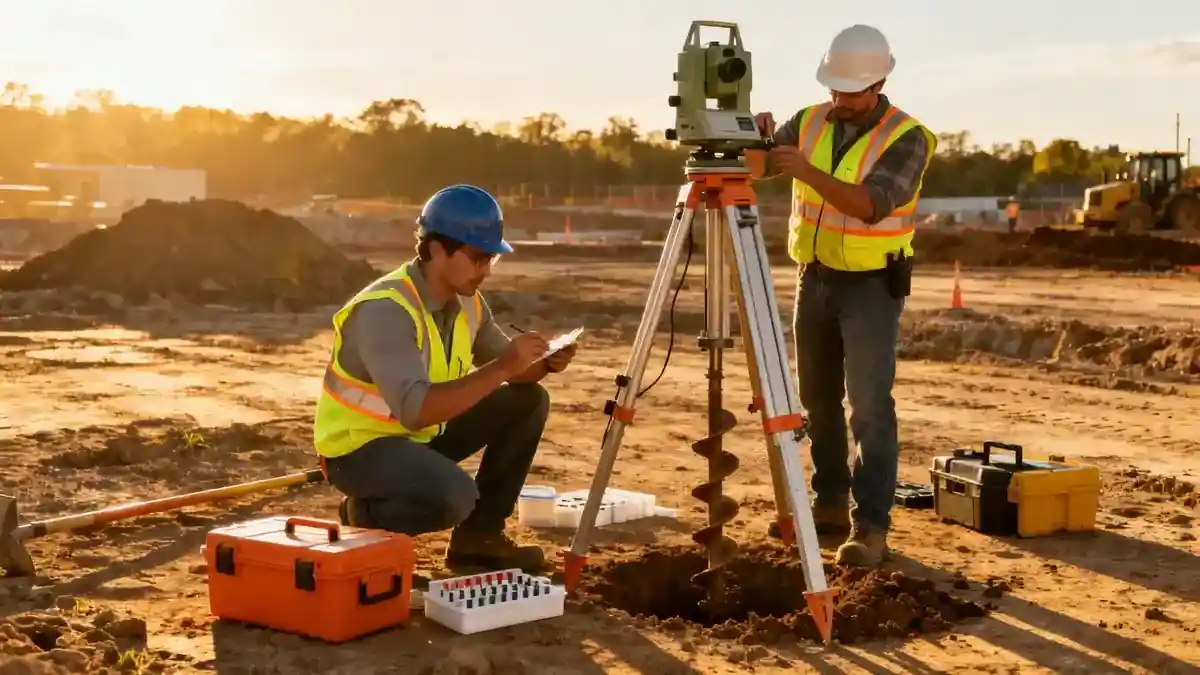
Our methodology for standard penetration test in Trenton New Jersey follows ASTM D1586, with split-spoon sampling at 1.5-meter intervals to capture soil variability. We use a 63.5-kg hammer dropped 0.76 m to drive the sampler, recording blow counts (N-value) at each depth. For cohesive soils, we collect undisturbed samples for laboratory testing. Our approach integrates site-specific seismic considerations per ASCE 7-16, including Site Class determination. For more details, see our standard penetration test (spt) service page.
Reference Technical Parameters
| Parameter | Reference Value |
|---|---|
| Predominant soil type | Glacial till (silty sand and gravel) over alluvial deposits (clay and silt) |
| Maximum seismic acceleration (PGA) | 0.20–0.25 g (ASCE 7-16, Site Class D) |
| Typical groundwater level | 2–5 m below surface (varies seasonally near river) |
| Bedrock depth | 10–30 m (Triassic sedimentary bedrock) |
| Typical N60 range | 5–30 blows/0.3 m (soft to dense sands; firm clays) |
Local Considerations — Trenton New Jersey
Trenton's geology is dominated by glacial till overlying Triassic sedimentary rocks, with alluvial deposits along the Delaware River. The shallow groundwater table (2–5 m) requires dewatering for deep excavations. Seismic hazard (PGA 0.20–0.25 g) mandates Site Class determination per ASCE 7-16. Historic districts like Mill Hill contrast with industrial zones near the river, influencing foundation design. Our team provides cone penetration test (cpt) services for continuous profiling in soft soils. Typical projects include urban redevelopment and bridge foundations.
Request a Quote
Our team reviews your project and issues an initial report at no cost.
Or write us directly at [email protected]
Services in Trenton New Jersey
Applicable Standards
- ASTM D1586 (Standard Test Method for Standard Penetration Test)
- ASCE 7-16 (Minimum Design Loads and Associated Criteria for Buildings)
- New Jersey Residential Site Improvement Standards (N.J.A.C. 5:21)
- IBC 2021 (International Building Code)
Frequently Asked Questions
What soil types are commonly encountered in Trenton, New Jersey?
Trenton typically features glacial till (silty sands and gravels) over alluvial deposits (clays and silts) near the Delaware River. Bedrock is Triassic sedimentary rock at depths of 10–30 m. Our standard penetration test services characterize these layers for foundation design.
What seismic design requirements apply to Trenton projects?
Per ASCE 7-16, Trenton falls in Seismic Design Category B to C, with PGA of 0.20–0.25 g. Site Class D (stiff soil) is common. Geotechnical reports must include SPT-based liquefaction assessment and Site Class determination per ASTM D1586.
Is a standard penetration test required for residential construction in Trenton?
While not always mandatory, SPT is recommended for homes with basements or on fill soils. New Jersey’s Residential Site Improvement Standards (N.J.A.C. 5:21) require geotechnical investigation for subdivisions and multi-family units to ensure bearing capacity and settlement criteria.