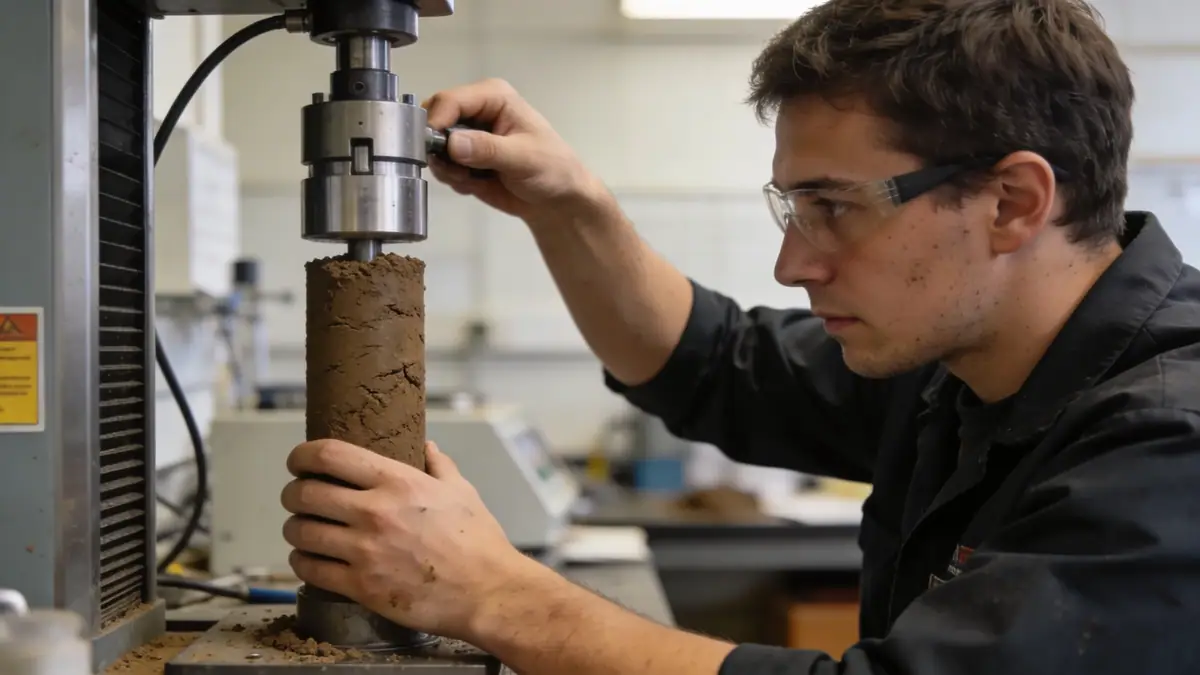
Methodology

Our methodology for standard penetration test (SPT) in Peoria follows strict ASTM D1586 protocols. We perform borings using 140-pound hammers with a 30-inch drop, recording N-values at 1.5-meter intervals. Continuous sampling and split-barrel recovery allow us to characterize soil layers, including sands, silts, and gravels typical of the Salt River Valley. This data informs bearing capacity and liquefaction potential assessments, critical for Peoria's seismic zone. For deeper investigations, we also offer cone penetration test (cpt) services.
Reference Technical Parameters
| Parameter | Reference Value |
|---|---|
| Predominant soil type | Silty sand (SM) and gravelly sand (SP) |
| Maximum seismic acceleration (PGA) | 0.25 g (ASCE 7-22, Site Class D) |
| Typical groundwater level | 15–30 m below surface |
| Bedrock depth | >50 m (basin fill) |
| Typical N60 range | 5–25 blows/ft (medium dense to dense) |
Local Considerations — Peoria Arizona
Peoria's geology is dominated by alluvial deposits from the Agua Fria River, with interbedded sands, silts, and gravels. Shallow soils are often loose, requiring SPT to verify compaction for slab-on-grade foundations. Seismic site classification per ASCE 7-22 typically falls as Site Class D, with peak ground acceleration of 0.25 g. Groundwater is deep (>15 m), rarely affecting excavations. Older neighborhoods near the river may have variable fill layers, while newer subdivisions on the west side encounter denser alluvium. SPT is essential for liquefaction assessment in this seismically active region. For broader coverage, our team also operates from standard penetration test en Phoenix.
Request a Quote
Our team reviews your project and issues an initial report at no cost.
Or write us directly at [email protected]
Services in Peoria Arizona
Applicable Standards
- ASTM D1586
- ASCE 7-22
- IBC 2021
- Arizona Building Code (Title 9)
Frequently Asked Questions
What soil types are typically found in Peoria, Arizona?
Peoria's subsurface consists of alluvial sands, silts, and gravels deposited by the Agua Fria River. These soils range from loose to dense, with occasional clay lenses. SPT is used to characterize their strength and stratification for foundation design.
Is seismic design required for projects in Peoria?
Yes, Peoria lies in a seismically active region with a PGA of 0.25 g per ASCE 7-22. Site-specific SPT data is crucial for determining soil liquefaction potential and site class (typically D), influencing structural design per the Arizona Building Code.
Are geotechnical investigations mandatory for construction in Peoria?
While not always mandatory for small residential projects, the City of Peoria strongly recommends SPT-based investigations for any structure with seismic or settlement concerns. Many lenders and insurers require a geotechnical report for risk assessment.