
Methodology
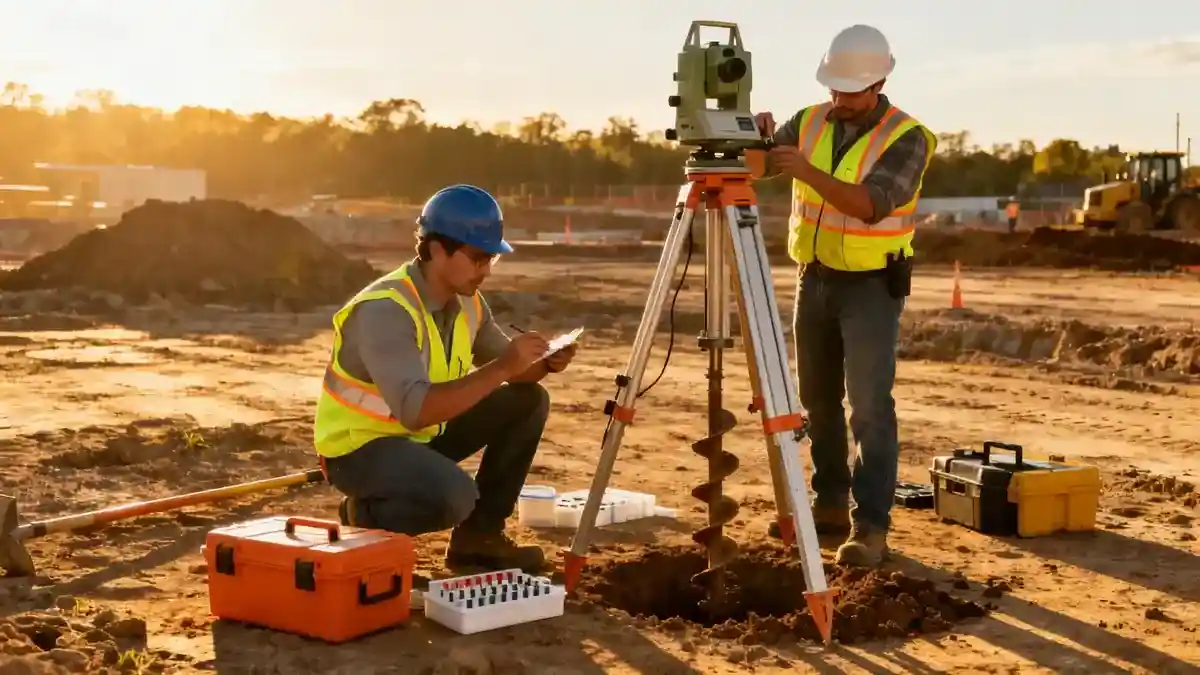
Our standard penetration test methodology in Milwaukee follows ASTM D1586, with split-spoon sampling at 1.5 m intervals to depths of 15–30 m depending on project requirements. We measure N60 values corrected for overburden and rod length, and our field team logs soil types and groundwater conditions in accordance with industry standards. For detailed stratification, we often integrate standard penetration test (spt) with continuous sampling and geophysical methods to capture the variability of Milwaukee's glacial and lacustrine deposits.
Reference Technical Parameters
| Parameter | Reference Value |
|---|---|
| Predominant soil type | Glacial till (silty clay, sand, gravel) and lacustrine clays |
| Maximum seismic acceleration (PGA) | 0.18–0.24 g per ASCE 7-22 |
| Typical groundwater level | 3–6 m below ground surface |
| Bedrock depth | 15–30 m (dolomite and shale) |
| Typical N60 range | 5–30 blows/0.3 m (till) to 2–10 blows/0.3 m (soft clay) |
Local Considerations — Milwaukee
Milwaukee's subsurface is dominated by glacial till and lacustrine deposits from the Pleistocene glaciation. Downtown and near Lake Michigan, bedrock (Niagara dolomite) is shallower (15–20 m), while western areas have deeper soil profiles with compressible clays. Seismic design per ASCE 7-22 requires site-specific evaluations due to variable soil stiffness. Groundwater is typically 3–6 m deep, affecting excavations and foundation types. Our team has extensive experience adapting standard penetration test to these conditions. For broader regional context, consider our servicios de standard penetration test desde Chicago. We also apply dpsh dynamic probing for rapid profiling in till deposits.
Request a Quote
Our team reviews your project and issues an initial report at no cost.
Or write us directly at [email protected]
Services in Milwaukee
Applicable Standards
- ASTM D1586
- ASCE 7-22
- IBC 2021
- Milwaukee Building Code Chapter 18 (Soils and Foundations)
Frequently Asked Questions
What soil types are encountered in Milwaukee during standard penetration tests?
Milwaukee's soils are primarily glacial till (silty clay, sand, gravel) and lacustrine clays. The till is dense with N60 values of 5–30, while soft lake clays can have N60 below 10. Bedrock is dolomite or shale at depths of 15–30 m.
Does Milwaukee require seismic site classification for standard penetration tests?
Yes, per ASCE 7-22 and IBC 2021, site class (A–F) must be determined using N60 values and shear wave velocity. Milwaukee's typical soils yield Site Class C or D, but soft clays may require Site Class E. Our standard penetration test data directly supports this classification.
Is a standard penetration test mandatory for building permits in Milwaukee?
For most commercial and multi-family structures, the Milwaukee Building Code requires a geotechnical investigation including standard penetration test. Single-family homes may be exempt if on stable till, but site-specific conditions often dictate the need.