
Methodology
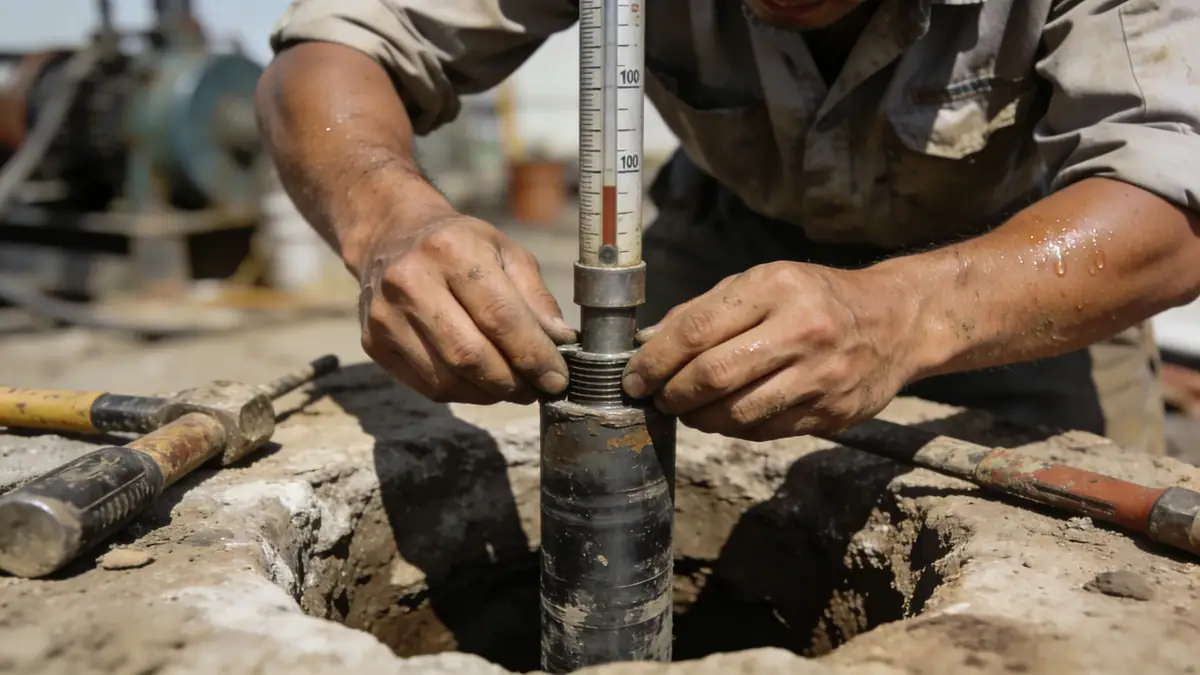
Our methodology for Standard Penetration Test in Hampton Virginia follows ASTM D1586, employing a 63.5 kg hammer falling 760 mm to drive a split-spoon sampler. We record blow counts per 150 mm interval, correcting for overburden and hammer efficiency to obtain N60 values. Typically, SPT borings extend to depths of 8–15 m for residential projects and up to 30 m for industrial sites, with sampling intervals every 1.0–1.5 m. Our team ensures quality control through calibrated equipment and real-time data logging. For detailed profiling, we integrate results with cone penetration test (cpt) soundings, providing a comprehensive understanding of subsurface conditions.
Reference Technical Parameters
| Parameter | Reference Value |
|---|---|
| Predominant soil type | Silty sand to clayey sand |
| Maximum seismic acceleration (PGA) | 0.15–0.25 g (ASCE 7) |
| Typical groundwater level | 1.5–3.0 m below surface |
| Bedrock depth | 20–50 m (variable) |
| Typical N60 range | 5–30 blows/300 mm |
Local Considerations — Hampton Virginia
Hampton's subsurface is dominated by Quaternary alluvial and estuarine deposits, including silty sands, clays, and occasional peat layers. The water table is shallow, typically 1.5–3.0 m, requiring careful dewatering or casing during drilling. Seismic hazard is moderate, with peak ground accelerations of 0.15–0.25 g per ASCE 7, influencing liquefaction assessments in loose granular soils. Distinct soil conditions exist between downtown areas (finer-grained fills) and coastal neighborhoods (sandy beach ridges). Typical projects include waterfront developments and residential subdivisions. Our team coordinates with local authorities to ensure compliance with Virginia's Uniform Statewide Building Code. For broader regional context, our team in Philadelphia offers similar expertise through standard penetration test en Philadelphia.
Request a Quote
Our team reviews your project and issues an initial report at no cost.
Or write us directly at [email protected]
Services in Hampton Virginia
Applicable Standards
- ASTM D1586
- ASCE 7
- Virginia Uniform Statewide Building Code (USBC)
- IBC 2021
Frequently Asked Questions
What soil types are commonly encountered in Hampton Virginia?
Hampton's soils are predominantly silty sands and clays from alluvial and estuarine deposits. Organic layers and peat may be present near the coast. The shallow water table and potential for liquefaction in loose sands require careful SPT evaluation.
How does seismic risk affect standard penetration testing in Hampton?
Hampton lies in a moderate seismic zone with PGA values of 0.15–0.25 g. SPT data is used to assess liquefaction potential via methods like Youd et al. (2001). Our testing follows ASTM D1586 to ensure reliable N60 values for seismic design per ASCE 7.
Is a geotechnical investigation mandatory for construction in Hampton Virginia?
Yes, the Virginia USBC requires geotechnical reports for most structures. SPT borings are standard for determining bearing capacity and settlement. Our firm provides compliant investigations tailored to Hampton's coastal geology.