
Methodology
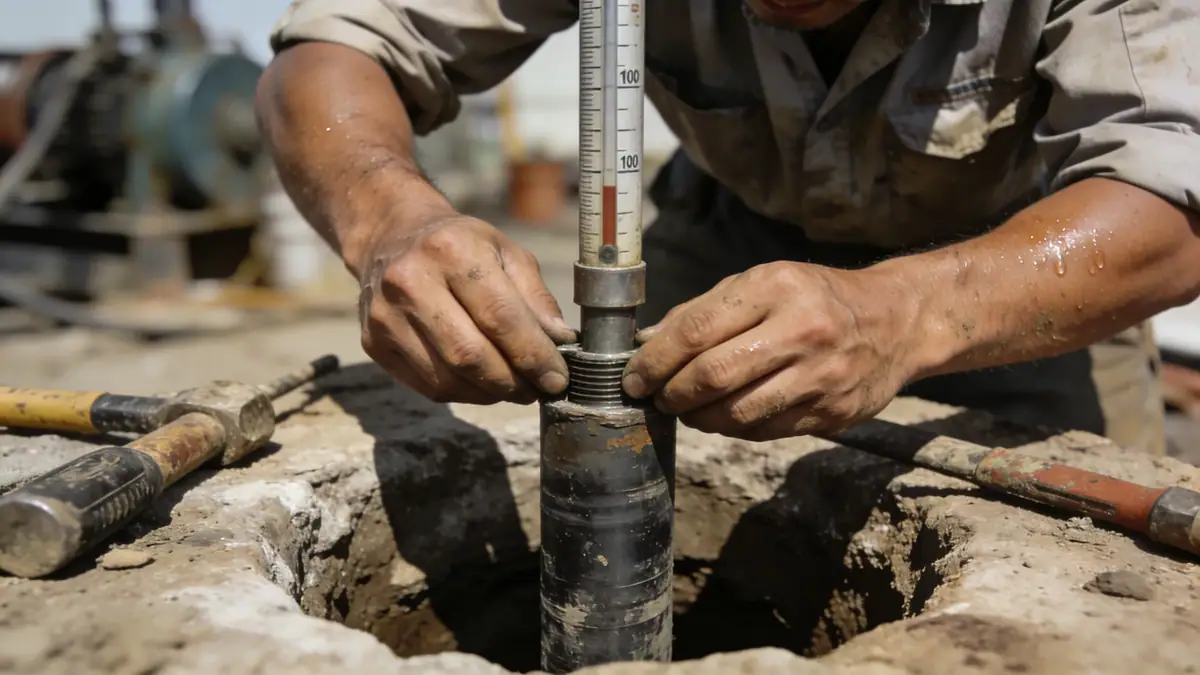
Our methodology for standard penetration test in Garland follows ASTM D1586, employing a 63.5 kg hammer dropped 760 mm to drive a split-spoon sampler. We record blow counts per 150 mm interval, with N-values corrected for overburden and energy efficiency. Sampling intervals are typically 1.5 m, with continuous sampling in critical zones. Our team also integrates cone penetration test (cpt) data where continuous stratigraphic profiling is required. All field work adheres to OSHA safety standards and local regulations. Laboratory testing includes moisture content, Atterberg limits, and unconfined compression on recovered samples, providing a comprehensive soil profile for foundation design.
Reference Technical Parameters
| Parameter | Reference Value |
|---|---|
| Predominant soil type | Clay (CH, CL) with interbedded sand lenses |
| Maximum seismic acceleration (PGA) | 0.1g to 0.15g (per ASCE 7-16) |
| Typical groundwater level | 3 to 10 m below grade |
| Bedrock depth | Variable, typically >30 m (Austin Chalk at depth) |
| Typical N60 range | 5-15 in clay, 15-30 in sand layers |
Local Considerations — Garland
Garland’s geology is dominated by expansive clay soils of the Blackland Prairie, which shrink and swell with moisture changes, leading to foundation movement. The area is classified as Seismic Design Category B per ASCE 7-16, with a mapped PGA of 0.1g. Groundwater is generally deep, but perched water can occur after heavy rains. Our team has extensive experience with these conditions, having completed numerous SPT investigations in neighborhoods like Lakewood and downtown. For clients requiring broader regional context, our standard penetration test en Houston hub provides additional insights. We also offer dpsh dynamic probing for shallow depth profiling in sensitive clay formations.
Request a Quote
Our team reviews your project and issues an initial report at no cost.
Or write us directly at [email protected]
Services in Garland
Applicable Standards
- ASTM D1586 - Standard Test Method for Standard Penetration Test (SPT)
- ASCE 7-16 - Minimum Design Loads for Buildings and Other Structures
- International Building Code (IBC) 2021
- City of Garland Municipal Code - Chapter 34 (Geotechnical Investigations)
Frequently Asked Questions
What soil types are commonly encountered in Garland during SPT?
The predominant soils are high-plasticity clays (CH) and low-plasticity clays (CL) of the Blackland Prairie. Interbedded sand and silt lenses are also present, particularly near streams. These expansive clays require careful evaluation for foundation design.
How does seismic risk affect standard penetration test requirements in Garland?
Garland is in Seismic Design Category B with low seismic hazard (PGA ~0.1g). However, site-specific SPT data is still required for liquefaction assessment in sandy layers and to determine soil classification per ASCE 7-16 for dynamic analysis.
Is a standard penetration test mandatory for building permits in Garland?
The City of Garland requires geotechnical investigations for most commercial and multi-family projects, and often for single-family homes on expansive soils. The SPT is the preferred method, as it provides both soil classification and strength parameters.