
Methodology
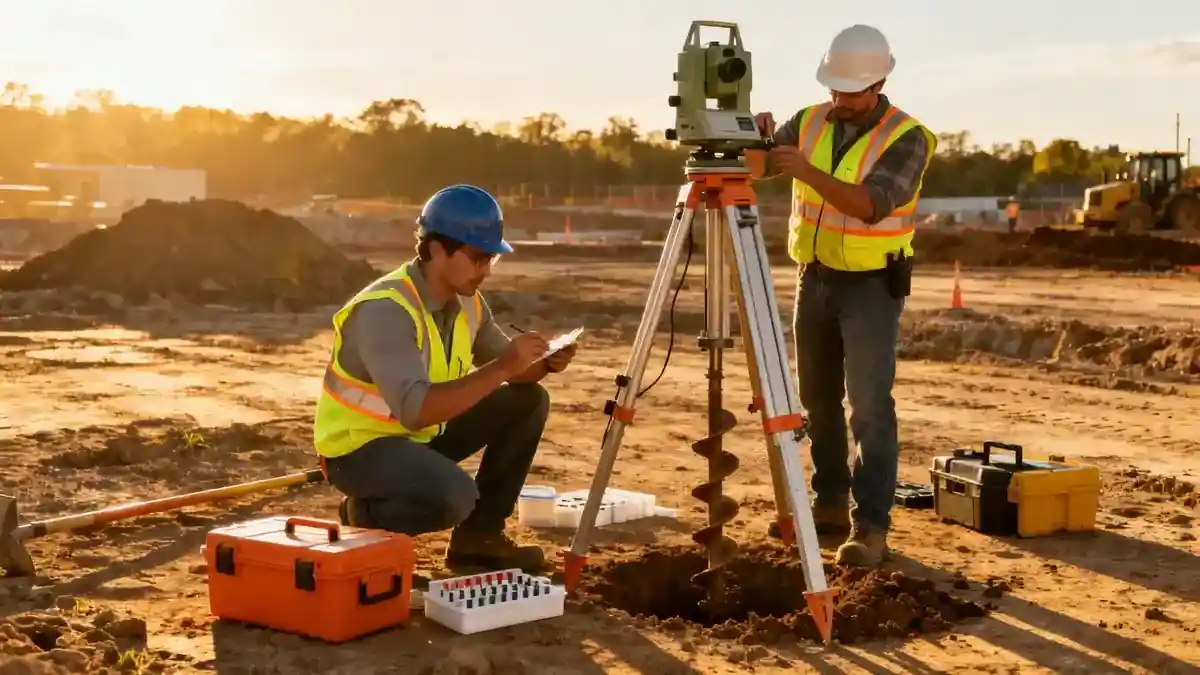
Our methodology for standard penetration test in Cleveland follows ASTM D1586, ensuring consistent and comparable N-values across all borings. We employ safety hammers with automatic trip mechanisms, recording blow counts for each 6-inch interval. Our team deploys truck-mounted drill rigs with hollow-stem augers to advance boreholes to target depths, typically 8 to 15 meters for residential projects and up to 30 meters for industrial facilities. Soil samples are retrieved using split-spoon samplers and visually classified in the field. We also integrate standard penetration test (spt) data with cone penetration tests (CPT) when continuous stratigraphic profiles are required. All drilling and sampling procedures comply with Ohio Department of Transportation and local municipality standards.
Reference Technical Parameters
| Parameter | Reference Value |
|---|---|
| Predominant soil type | Glacial till and lacustrine clay |
| Maximum seismic acceleration (PGA) | 0.15g (ASCE 7-16, Site Class D) |
| Typical groundwater level | 3 to 6 meters below grade |
| Bedrock depth | 30 to 60 meters (Devonian shale) |
| Typical N60 range | 5 to 40 blows per foot |
Local Considerations — Cleveland
Cleveland's subsurface is dominated by glacial deposits from the Wisconsinan glaciation, including lacustrine clays (Lake Maumee, Lake Whittlesey) and end moraines. These clays are often overconsolidated and exhibit sensitivity, requiring careful handling during sampling. Groundwater levels are shallow near the lakefront and deeper inland. Seismic design per ASCE 7-16 classifies most of Cleveland as Seismic Design Category B (PGA 0.10–0.15g), but soft clays can amplify ground motions. Our team has extensive experience in downtown lakefront projects and suburban residential developments. For broader regional context, our standard penetration test en Chicago operations provide analogous insights into Great Lakes geology. Additionally, we offer cone penetration test (cpt) for continuous profiling in sensitive clays.
Request a Quote
Our team reviews your project and issues an initial report at no cost.
Or write us directly at [email protected]
Services in Cleveland
Applicable Standards
- ASTM D1586
- ASCE 7-16
- Ohio Building Code (OBC)
- Cleveland Municipal Code Title 7
Frequently Asked Questions
What are the typical soil conditions encountered in Cleveland for SPT?
Cleveland's soils are primarily glacial till and lacustrine clay, with interbedded sand and gravel lenses. N60 values range from 5 to 40 blows per foot. Soft clays near the lakefront may require CPT for detailed profiling.
Does Cleveland require geotechnical investigations for all new construction?
The Ohio Building Code mandates geotechnical reports for most structures, except minor residential alterations. Seismic design per ASCE 7-16 requires site-specific soil data, especially for buildings in Seismic Design Category B or higher.
What seismic considerations apply to SPT in Cleveland?
Cleveland is in Seismic Design Category B with PGA up to 0.15g. Site Class D (stiff soil) is common. SPT N-values are used to evaluate liquefaction potential in sand lenses and to determine site coefficients for seismic design.